
Choosing the right stretch film thickness is an important part of creating a secure, efficient, and cost-effective packaging process. Stretch film is not simply a material that is wrapped around a pallet to hold products together. Its thickness, stretch performance, puncture resistance, holding force, and compatibility with the load all influence how well the finished package performs during handling, storage, and transportation.
Many buyers make the mistake of choosing stretch film only by micron or gauge. While thickness is an important specification, it should not be considered on its own. A lightweight and stable pallet may perform very well with a thinner film, while a heavy, irregular, or sharp-edged load may require a different film construction and higher puncture resistance. The way the film is applied also matters because hand wrapping and machine wrapping can place very different demands on the material.
The goal should not be to select the thickest stretch film available. The better approach is to identify the minimum film performance needed to keep the load stable throughout its handling and transportation journey. This helps prevent unnecessary material consumption while maintaining reliable load protection.

What Does Stretch Film Thickness Mean?
Stretch film thickness describes how thick the plastic film is before it is applied and stretched around a load. It is commonly expressed in microns in many international markets, while some packaging markets also use gauge or mil as measurement systems. The measurement itself is important, but it does not tell the entire story about how a stretch film will perform.
A film with a higher thickness generally contains more material in each unit of film area, which can contribute to greater resistance to punctures and tearing. However, this does not automatically mean that a thicker film will always produce a better pallet. Modern stretch films can be engineered to achieve strong performance at lower thicknesses through resin selection, film structure, manufacturing technology, and controlled stretching characteristics.
This is why thickness should be treated as one part of the overall film specification rather than the only factor in a purchasing decision.
For buyers comparing different stretch films, it is useful to consider thickness together with tensile strength, elongation, puncture resistance, tear resistance, cling, holding force, and the wrapping method being used. Two films with similar thickness can perform differently depending on their formulation and construction.
Your existing article discusses the relationship between gauge, micron, and mil, but the more important purchasing question is how those measurements relate to the actual load being wrapped.
Why Choosing the Correct Thickness Matters
The thickness of stretch film affects more than the appearance of a wrapped pallet. It can influence how the load behaves when it is moved by forklifts, stored in a warehouse, transported by truck, or exposed to repeated handling.
If the selected film is too thin for the application, the material may be more vulnerable to punctures, breaks, or loss of holding performance. A film failure during wrapping can slow down operations and force an operator to restart part of the wrapping process. More importantly, insufficient load security can allow cartons or products to shift during transportation.
Selecting a film that is unnecessarily thick creates a different problem. The pallet may be adequately protected, but more material than necessary is being consumed. Over time, this can increase packaging costs and create avoidable plastic consumption across thousands of pallets.
For this reason, the right stretch film thickness is usually a balance between load stability, puncture resistance, stretch performance, application method, operating conditions, and packaging cost.
The best specification is the one that provides the required performance consistently rather than simply the highest thickness.
Start With the Load You Need to Wrap
The first question when choosing stretch film thickness should be: What exactly are you wrapping?
The total weight of the pallet is important, but it is not the only consideration. You should also examine the dimensions of the pallet, the height of the load, how evenly the products are distributed, whether the corners are sharp, and how stable the individual cartons or components are before wrapping.
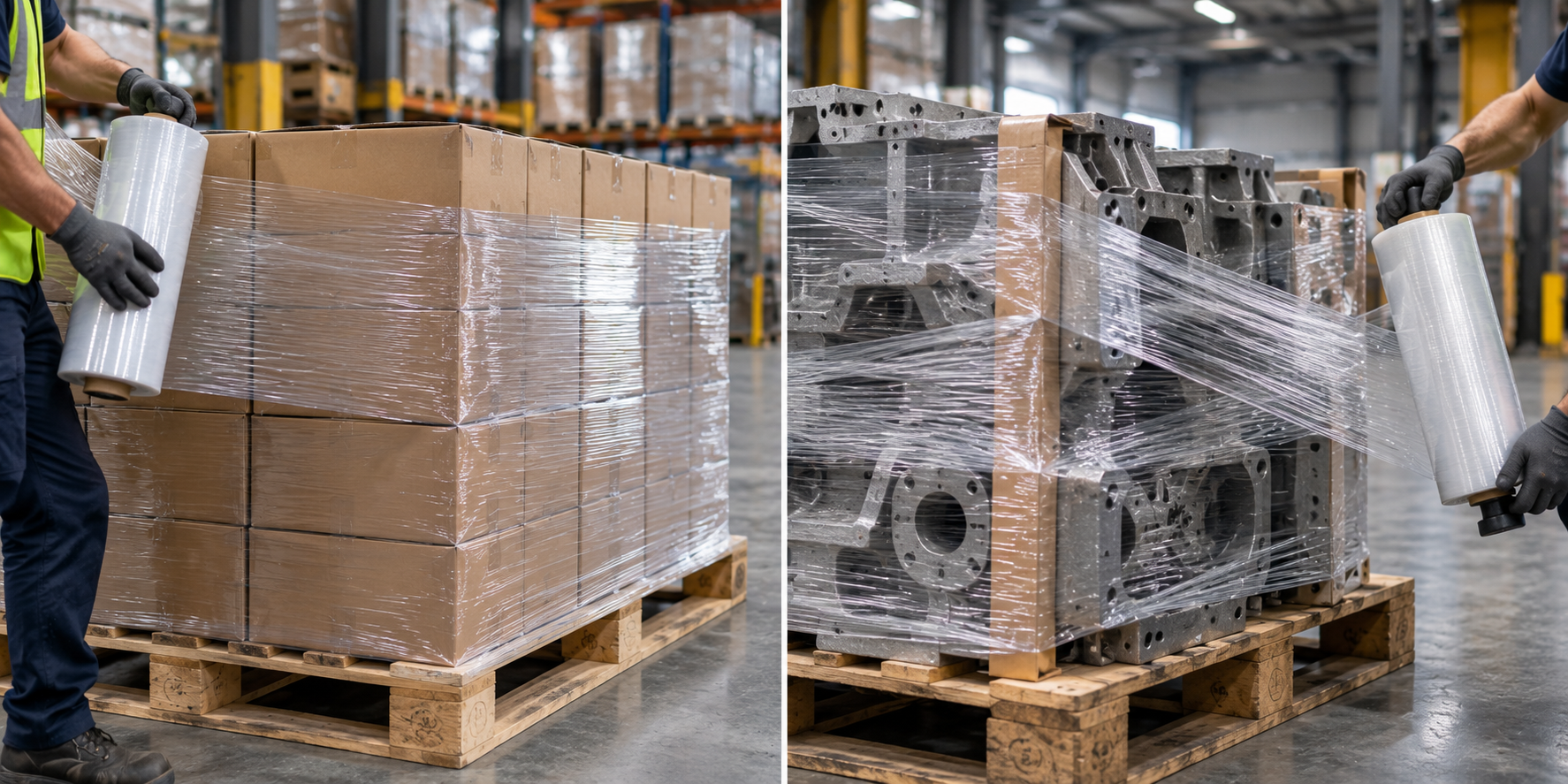
A pallet made up of uniform cartons with flat surfaces is generally easier to wrap than a pallet containing irregular machinery parts, metal components, long products, or cartons that extend beyond the pallet edges.
The load profile matters because the film has to stretch around the products while maintaining enough resistance to remain intact. A sharp corner can place much more stress on the film than a smooth carton surface. Similarly, a tall and unstable pallet may require more attention to holding force and wrapping pattern than a compact and well-balanced pallet.
This means two pallets with the same weight may require different stretch film specifications.
Load Weight Is Important, But Weight Alone Is Not Enough
It is common to hear that heavier pallets require thicker stretch film. There is some logic behind this because heavier loads can create greater forces during transport and handling. However, using load weight as the only selection factor can result in poor film choices.
Imagine two pallets that each weigh 800 kilograms. One consists of tightly stacked cartons with a uniform shape. The other contains machinery components with exposed edges, uneven surfaces, and spaces between products. Although the weights are identical, the second pallet presents a much more demanding wrapping application.
The irregular pallet may require higher puncture resistance and better film performance around difficult edges. In contrast, the uniform carton pallet may be successfully secured using a lighter film when the wrapping process is properly controlled.
This is why experienced packaging buyers evaluate the behavior of the load, not just its weight.
Consider the Shape and Stability of the Load
Load geometry is one of the most overlooked factors in stretch film selection.
A rectangular pallet with products stacked neatly inside the pallet footprint creates relatively predictable wrapping conditions. The film can travel around the load smoothly, and the corners are usually consistent from one turn to the next.
An irregular load is different. Products may extend beyond the pallet, surfaces may change from one section to another, and sharp corners may create concentrated stress on the film.
In these applications, choosing a film solely because it has a specific micron value may not solve the real packaging problem. The film may need better puncture resistance, stronger tear propagation resistance, or a different stretch-performance profile.
The wrapping pattern should also be considered. A load that requires more passes or specific reinforcement around the top and bottom may behave differently from a simple box-shaped pallet.
In practice, film thickness and wrapping technique should be selected together.
How Pallet Size Affects Stretch Film Selection
Pallet dimensions also influence film consumption and wrapping performance.
A short, compact pallet may require relatively little film to complete a wrapping cycle. A very tall pallet can require considerably more film because the wrapper must travel over a greater vertical distance.
The same applies to wide loads and pallets with unusual dimensions. A film specification that works efficiently for one pallet size may not produce the same material consumption or holding performance on another.
This becomes particularly important for companies operating mixed pallet sizes. Instead of choosing film based on only one “typical” pallet, packaging managers should look at the full range of loads moving through the facility.
Where a large variation exists, it may be useful to establish film specifications for different load groups rather than forcing every application into a single film thickness.
Choosing Stretch Film for Light Loads
Light loads are often suitable for thinner stretch films, particularly when the products are stable, evenly stacked, and have smooth surfaces.
For example, cartons containing lightweight packaged goods may not require the same puncture resistance as heavy industrial components. Using an unnecessarily thick film in this situation may increase material consumption without providing a meaningful improvement in load security.
However, lightweight does not always mean easy to wrap. A lightweight pallet can still be difficult if products are unstable, have sharp corners, or are poorly arranged.
Therefore, thin-film selection should be based on the combination of weight, geometry, stability, and handling conditions rather than weight alone.
Choosing Stretch Film for Medium-Duty Loads
Medium-duty pallet loads represent a large portion of everyday industrial and warehouse packaging. These loads may include cartons, consumer goods, packaged components, raw materials, and products being moved through distribution centers.
For these applications, the main objective is usually to achieve dependable load containment while keeping film consumption under control.
A medium-duty application can often benefit from a balanced film specification rather than simply moving to a heavier thickness. The packaging team should examine whether the current problem is actually caused by inadequate thickness or whether the issue is related to incorrect stretch, excessive wrapping speed, insufficient overlap, poor pallet stacking, or an unsuitable wrapping pattern.
This distinction is important because changing thickness does not always solve an application problem.
Choosing Stretch Film for Heavy Loads
Heavy pallets place greater demands on the packaging system because the load can generate significant movement during handling and transportation.
Heavy industrial products, machinery components, construction materials, metal products, and dense cartons may require film with greater resistance to punctures and tears. The wrapping process may also need additional attention to the bottom of the pallet and the connection between the load and pallet itself.
For heavy loads, buyers should evaluate not only the film thickness but also its ability to maintain load containment after stretching. A film that is simply thick but does not deliver suitable holding performance may not be the most efficient solution.
This is where technical film specifications become particularly important. A professional stretch-film supplier should be able to discuss the relationship between film thickness, stretch capability, load type, and wrapping method rather than recommending thickness based on weight alone.
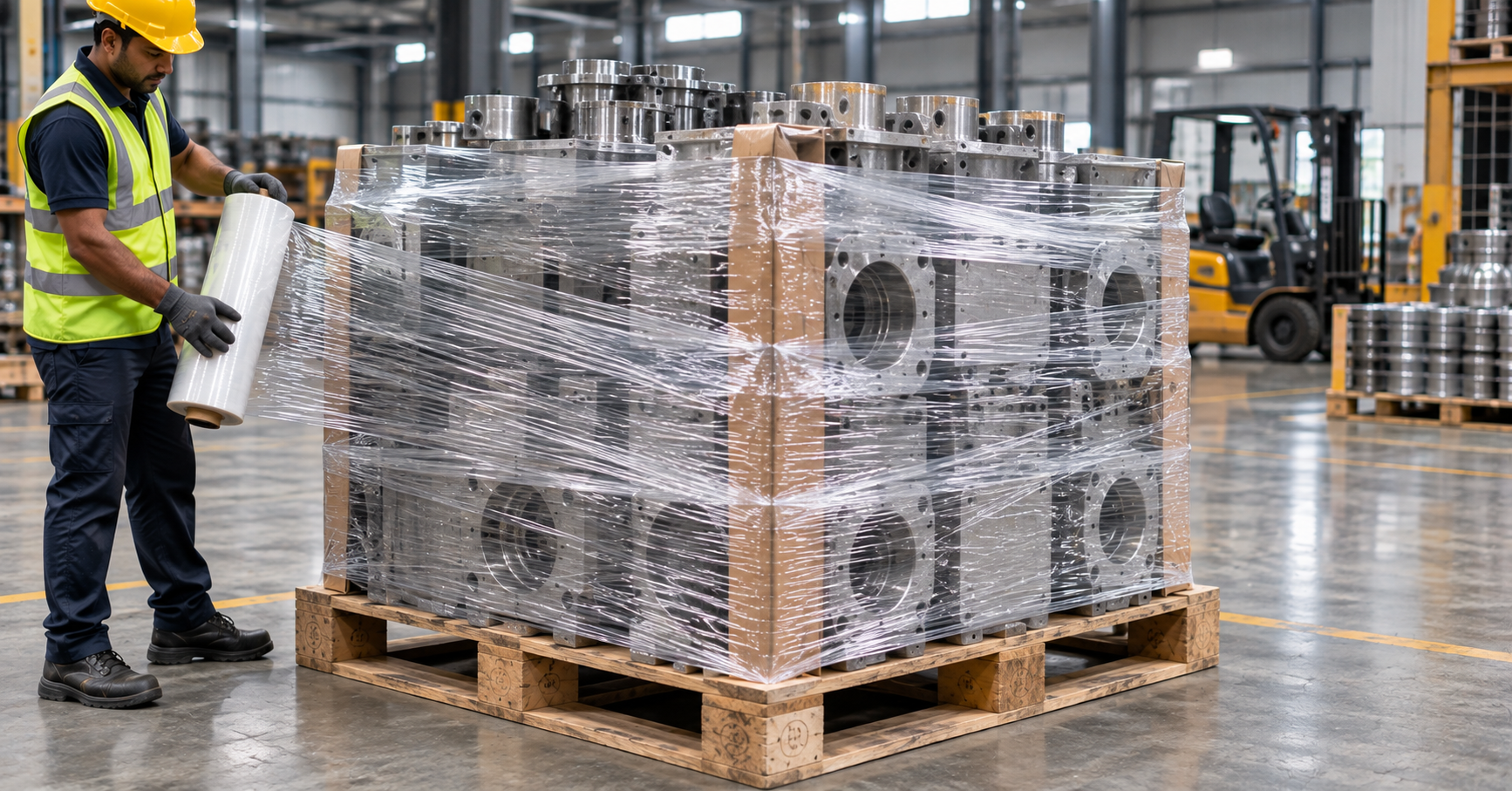
Sharp Edges and Irregular Loads Need Special Attention
One of the biggest reasons stretch film fails is not necessarily insufficient thickness. Sharp corners and irregular surfaces can create concentrated stress points that damage the film during application.
When a pallet contains metal components, machinery parts, wooden products, or cartons with exposed edges, the film may come under more stress as it is stretched around the load.
In these cases, buyers should consider puncture resistance and film toughness along with thickness. Depending on the application, additional protective materials may also be used at particularly difficult corners before the stretch film is applied.
A thicker film can help in some demanding applications, but thickness should still be evaluated together with film construction and wrapping conditions.
Thickness Is Not the Same as Strength
This is one of the most important concepts to understand when buying stretch film.
A thicker film can offer greater resistance to certain types of damage, but thickness alone does not define overall film strength.
Stretch film performance can be influenced by resin formulation, manufacturing process, molecular structure, orientation, elongation, puncture resistance, and other technical characteristics.
For this reason, comparing two products only by micron can be misleading.
Suppose one film is slightly thinner but has significantly better stretch and puncture performance than another film with greater thickness. The thinner product may deliver equal or better practical performance while using less material.
This is why professional buyers should look beyond a single specification and ask the manufacturer how the film performs under the intended wrapping conditions.
The Difference Between Hand Stretch Film and Machine Stretch Film
The application method should be considered before deciding on thickness.
Hand stretch film is applied manually, which means operator technique can vary. The amount of tension created during wrapping can depend on the dispenser, operator strength, wrapping speed, overlap, and method used around the pallet.
Machine stretch film is applied through a controlled wrapping system. Depending on the machine and film specification, the material may be pre-stretched before reaching the load. This can significantly change how much film is consumed and how the final pallet is secured.
Because of these differences, a film that works well in a hand-wrapping operation should not automatically be considered the best choice for a machine wrapping system.
Your website already has dedicated pages for both Hand Stretch Film and Machine Stretch Film, so this article should guide readers toward those product pages when they reach the point of selecting an application-specific solution.
Pre-Stretch Changes How You Think About Thickness
Pre-stretch film deserves special consideration because it is designed to be stretched mechanically before being applied around the load.
The film can therefore achieve a greater level of extension during the wrapping process without requiring the same manual effort from the operator. This can reduce film consumption in suitable applications while still maintaining load security.
That means a buyer should not compare a conventional film and a pre-stretch film only by their initial thickness.
The more useful comparison is performance per pallet.
How many meters of film are consumed? How stable is the load? How many wraps are required? How much film is applied to each pallet? How often does the film break? What is the total packaging cost?
These questions provide much more useful information than comparing micron values alone.
For companies looking to reduce material consumption, pre-stretch film can therefore become part of a wider packaging-efficiency strategy.
Stretch Film Thickness and Cost
It may seem obvious that thicker film costs more because more plastic material is used, but the real packaging cost should be evaluated at the pallet level.
A lower-cost roll is not necessarily the lowest-cost packaging solution.
For example, if a cheaper film requires more wraps per pallet, breaks during application, or consumes significantly more material, the apparent saving in price per roll may disappear once the actual packaging process is measured.
On the other hand, a higher-performance film may cost more per roll but consume less film per pallet and reduce packaging labour or product damage.
This is why purchasing decisions should consider cost per wrapped pallet rather than only price per roll.
For larger warehouses and manufacturing facilities, even a small improvement in film consumption can become significant when multiplied across hundreds or thousands of pallets every month.
How to Choose Stretch Film Thickness for Different Applications
There is no universal thickness that is suitable for every pallet.
A lightweight, stable carton load may perform well with a relatively thin film. A standard warehouse pallet may require a moderate-duty specification. A heavy industrial load with sharp edges may require a tougher film with higher resistance to puncture and tearing.
Outdoor storage creates another consideration because the packaging may face sunlight and changing environmental conditions. In such situations, UV-resistant stretch film can be more appropriate than choosing standard stretch film based only on thickness. Your website already has a dedicated UV Stretch Film product page and an existing article focused on outdoor pallet protection.
Metal products present a different requirement. When corrosion protection is important, VCI stretch film may be more appropriate because the packaging objective is not simply securing the pallet but also helping protect metal components from corrosion.
This is a useful reminder that the correct film type comes before the final thickness decision.
Environmental and Storage Conditions Also Matter
The journey of the pallet should be considered before the film is selected.
A pallet stored indoors in a controlled warehouse may face very different conditions from a pallet that spends days outdoors, moves through a port, or remains in a container yard.
Temperature changes can influence film behavior, while sunlight can affect conventional plastic films during extended outdoor exposure.
Humidity and environmental exposure may also matter when the products themselves are sensitive. In those situations, the packaging requirement should be evaluated as a complete system rather than focusing exclusively on film thickness.
For outdoor applications, the discussion should include UV resistance. For metal products, corrosion protection may be important. For agricultural applications, such as silage bales, the film specification and application method are entirely different from pallet wrapping.
In other words, the right thickness cannot be separated from the purpose of the film.
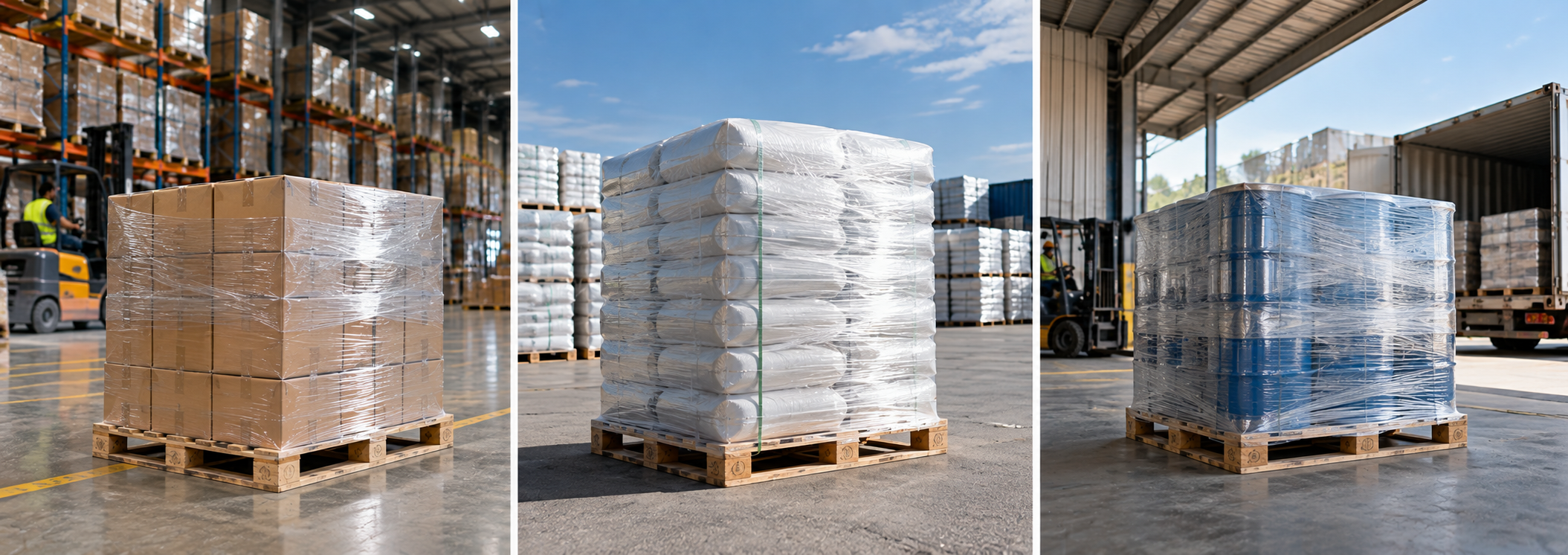
Common Mistake: Choosing the Thickest Film
One of the most common misconceptions in packaging is that thicker automatically means better.
It is easy to understand why this assumption exists. A thicker piece of plastic can feel stronger in your hand, so it seems natural to believe that selecting a thicker film will always improve pallet security.
But packaging performance is not determined by thickness alone.
A film that is too thick for a particular application may increase cost and material usage without solving the actual load-security problem. If the issue is poor wrapping technique, insufficient stretch, poor overlap, unstable stacking, or unsuitable film properties, simply increasing thickness may not address the root cause.
The better approach is to identify why the pallet is failing and then select the film specification that addresses that specific problem.
Common Mistake: Choosing Film Only by Micron
Another frequent purchasing habit is to request a certain micron and compare supplier quotations entirely on that number.
This makes price comparisons appear simple, but it can hide differences in film performance.
A buyer should ideally compare the complete specification, including film thickness, width, stretch percentage or capability, film type, puncture resistance, tensile properties, application method, and intended load type.
For machine wrapping applications, the machine itself and its available settings should also be considered.
Two films that have the same nominal thickness may not provide identical results when used on the same pallet.
A good supplier should help connect the film specification with the packaging application rather than treating micron as the only purchasing criterion.
Common Mistake: Ignoring Film Stretch
Stretch film is designed to stretch. That characteristic is a central part of how the film works.
The relationship between the film’s original dimensions and its stretched dimensions can affect how much material is actually consumed and how much holding force is generated around the load.
This is why two films with identical nominal thicknesses can produce very different packaging costs.
A buyer may initially think that a thicker film is more economical because it feels stronger. However, if a technically better-performing film can achieve the required load containment using less material per pallet, the total cost may be lower.
The correct question is therefore not simply:
“How thick is the film?”
It is:
“How much film do I need to use to secure this load reliably?”
That is the question that matters most in real packaging operations.
A Better Way to Select Stretch Film Thickness
The most reliable method is to evaluate the complete packaging application.
Start with the product and pallet. Look at the total load weight, dimensions, shape, stability, surface characteristics, corners, and whether the products move during handling.
Then evaluate the wrapping process. Determine whether the film is applied manually or by machine, how much stretch is being used, how many wraps are required, and whether the current film experiences breaks or punctures.
After that, consider the transportation and storage environment. Outdoor exposure, temperature variation, long-distance shipping, export handling, and repeated movement can all affect the required packaging performance.
Only after reviewing these factors should thickness be selected.
This approach prevents the common mistake of starting with a number and trying to make the application fit the number.
A Practical Stretch Film Thickness Selection Example
Consider a warehouse shipping two different pallet types.
The first pallet contains lightweight cartons that are stacked evenly and transported directly from the warehouse to a nearby distribution center. The load has smooth surfaces and very few sharp edges.
The second pallet contains heavy engineering components with uneven shapes and exposed metal edges. The pallet will be transported over a longer distance and may be handled multiple times before reaching the customer.
Using exactly the same stretch film specification for both pallets may not be the most efficient approach.
The first application may be suitable for a lighter film designed to provide adequate holding performance with efficient material usage. The second application may require stronger resistance to puncture and tearing as well as a wrapping method that provides higher load containment.
The lesson is simple: film selection should follow the application, not the other way around.

Should You Use the Same Stretch Film Thickness for Every Pallet?
For some operations, using one standard film can make purchasing and warehouse operations easier. However, this does not automatically make it the most cost-effective approach.
If the facility handles a wide range of loads, a single film specification may be unnecessarily heavy for some products and insufficient for others.
Companies with high pallet volumes can benefit from dividing their packaging requirements into a small number of load categories. For example, light stable loads, standard mixed-carton loads, and heavy or irregular industrial loads may each have different film requirements.
The objective is not to create dozens of film specifications. It is to create a practical system where each major load type receives enough film performance without excessive material usage.
A packaging supplier can help determine whether a single specification or a small family of specifications is more appropriate for the operation.
How to Test Whether Your Current Film Thickness Is Correct
Before changing film thickness across an entire operation, it is useful to evaluate the existing packaging process.
Look at how the film behaves during application. Does it break easily? Does it puncture around corners? Does it require excessive wrapping? Does the pallet remain stable after transportation? Are cartons shifting inside the load? Is the film being consumed faster than expected?
These observations can reveal whether the problem is actually thickness or another part of the packaging process.
A controlled trial is often more useful than selecting a new film based purely on a specification sheet. Compare two or more film options using the same pallet type and similar wrapping conditions. Measure film consumption, number of wraps, visible damage, load stability, and overall packaging cost.
This turns film selection into a measurable packaging decision rather than a guess.
Choosing the Right Stretch Film Supplier
The supplier you choose can be just as important as the thickness you select.
A capable manufacturer should be able to understand your application and recommend a film based on actual packaging requirements. They should be able to discuss different film types, thicknesses, widths, stretch characteristics, and suitable applications.
This is particularly important for businesses purchasing stretch film in bulk because a small improvement in material efficiency can have a meaningful effect on annual packaging expenditure.
Rather than asking only for the cheapest film in a specific micron, buyers should explain the load type, wrapping method, pallet dimensions, transportation conditions, and the problems they are currently experiencing.
This allows the manufacturer to recommend a more appropriate specification.
Final Thoughts: Choose Film Performance, Not Just Thickness
Choosing the right stretch film thickness is ultimately about finding the right balance between protection, performance, material efficiency, and cost.
A pallet is not simply heavy or light. It has a specific shape, surface, stability, packaging requirement, handling process, and transportation journey. All of these factors influence the film specification that will work best.
The most effective packaging strategy is therefore not to select the thickest film or automatically choose the cheapest roll. It is to identify the required level of performance and select a film that can achieve that performance efficiently.
For businesses using large quantities of stretch film, the difference between an appropriate film specification and an unnecessarily heavy one can become significant over time. Evaluating film thickness together with stretch performance, puncture resistance, application method, and actual film consumption can help reduce packaging waste while maintaining reliable load security.
For more information about selecting the right film for your operation, explore our Hand Stretch Film, Machine Stretch Film, and Pre Stretch Film solutions, or contact StretchFilm.in to discuss your specific packaging requirements.